- Conveline Systems
- 20th Oct 2026
- Blogs
Key Takeaways
- Understand how an omni wheel diverter unit operates to efficiently redirect products in conveyor sorting systems.
- Explore the benefits of reduced manual handling and smoother product transfers with a Wheel Diverter Unit Manufacturer's systems.
- Learn about customizable options including 30°, 45°, and 90° diversion angles for optimal routing solutions.
- Discover applications of the wheel diverter in various industries such as e-commerce, logistics, and manufacturing.
- Find out how sensor integration and automation enhance efficiency in automated material handling processes.
On a busy sorting line, a wrong turn can send a carton towards the wrong packing or dispatch area. Buyers looking for a Wheel Diverter Unit Manufacturer require a system that smoothly redirects products to different conveyor paths without stopping the main conveyor.
At Conveline Systems Pvt. Ltd., we design omni-wheel diverter units for routing, merging, transferring and rejecting products. Our compact design supports new installations and upgrades to existing lines.
How Omni Wheels Redirect Products on a Moving Line
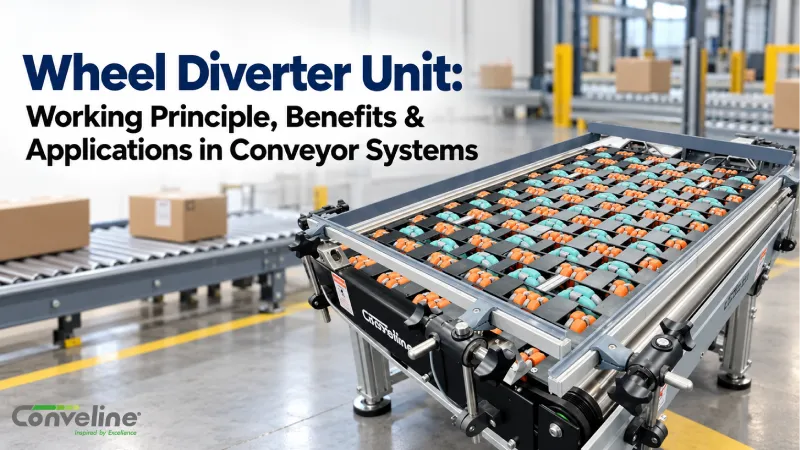
Our omni wheel diverter unit uses low-friction wheels that allow a supported package to change direction at a transfer point. When an item must leave the straight route, the diverter guides it towards the selected branch. Other products can continue along the main conveyor according to the operating sequence.
We offer fixed and pneumatic lift-type configurations, with manual or automatic operation. The lift-type option allows the diverter to engage when diversion is required, depending on the final installation design. Our team considers the package base, required movement and available space before discussing a configuration. This matters when cartons, trays and plastic totes share a facility but follow different routes.
Choosing Between 30°, 45° and 90° Diversion
Our available diversion angles are 30°, 45° and 90°. A shallow diversion can suit a branching route, while a right-angle transfer may be useful where downstream equipment calls for a sharper turn. We review the physical layout rather than assuming one angle will work for every sorting station.
The unit is available with a powder-coated mild steel frame or stainless steel 304 construction. We also support multiple conveyor widths and custom layouts. These options matter when connecting a conveyor sorting system to packing or dispatch areas. Buyers should share package dimensions, orientation and the required exit direction before choosing the layout.
Benefits Beyond Simply Changing Direction
Controlled diversion can reduce the need to move packages manually between conveyor sections. Our omni-directional wheels are designed for low-friction movement, helping cartons transfer smoothly at a junction. A compact modular design can also fit a sorting requirement within an existing line without replacing every conveyor section.
We offer sensor integration together with PLC and VFD compatibility for automatic routing. For facilities investing in automated material handling, the diverter can work within a wider sorting arrangement that includes conveyor controls. Our heavy-duty construction is intended for continuous use, with maintenance-friendly design. Actual throughput depends on product size, conveyor speed and system controls, so we review those details before specifying a solution.
Applications Across Warehouses and Production Facilities
Our diverter suits carton sorting, distribution centres, e-commerce warehouses and order fulfilment systems. In packaging operations, a diversion point can send boxes towards the next relevant process. In logistics, it can direct selected packages to different dispatch routes or checking points.
The product also addresses food and beverage, pharmaceutical, FMCG and manufacturing applications. Our suitable product list includes cartons, boxes, trays, plastic totes and packages. Polybags require suitable support, so we do not treat every flexible bag as an automatic fit. Product stability at the transfer point should be reviewed before final selection.
What Buyers Should Confirm Before Installation
A Wheel Diverter Unit Manufacturer should review the conveyor route before recommending hardware. We discuss the required angle, conveyor width, product characteristics and whether the operation needs manual or automatic control. These inputs guide the choice between fixed and pneumatic lift-type arrangements.
Our unit supports sensor integration and PLC and VFD compatibility. We can examine those options during conveyor automation design consulting and system design support. A layout drawing and sample package details make the discussion more productive because they show how items must enter, divert and leave the junction.
Why Choose Conveline Systems Pvt. Ltd.?
We provide conveyor design assistance along with flexible wheel diverter solutions that support 30°, 45°, and 90° product diversion. Our team reviews installation space, product type and control requirements before discussing a configuration. With mild steel and stainless steel 304 frame options, we can address construction requirements alongside the product transfer path for a particular project.
Conclusion
A useful diversion station moves the intended package towards the right destination while keeping the main conveyor organised. Our wheel diverter offers omni-directional movement, several routing angles and manual or automatic operation. For warehouse sorting, packaging and distribution facilities, the appropriate configuration depends on the items handled and the wider conveyor layout. We start with those practical details rather than making assumptions about every application.
Looking for a Wheel Diverter Unit Manufacturer for a sorting line? Speak with Conveline Systems Pvt. Ltd. about your layout and products. Call +91 90819 15912 or email info@conveline.com to discuss your requirement.
Frequently Asked Questions
Wheel Diverter Unit Wheel Diverter Unit Manufacturer Omni Wheel Diverter Conveyor Sorting System Conveyor Diverter Material Handling Automation Conveyor Routing Carton Sorting Warehouse Automation Conveyor Systems

Table of Contents
- Introduction