- Conveline Systems
- 3 Aug 2026
- Blogs
Key Takeaways
- Belt conveyors provide continuous support for diverse product shapes, enhancing operational efficiency in various industries.
- Roller conveyors excel in transporting flat-based products, making them ideal for logistics and assembly applications.
- Selecting the right conveyor system depends on product type, load capacity, and facility layout.
- Partnering with a trusted Belt Conveyors Systems Manufacturer ensures tailored solutions for improved workflow and productivity.
- Both belt and roller conveyors require routine maintenance to ensure operational reliability and longevity.
Conveline Systems Pvt.Ltd. is a leading manufacturer of Belt Conveyors Systems designed to support efficient material handling across manufacturing, warehousing, packaging, and logistics industries. Choosing the right conveyor system can significantly improve workflow, reduce manual handling, and increase operational productivity. However, many businesses find it challenging to decide between a belt conveyor and a roller conveyor because both serve different purposes. Understanding their differences helps industries select a system that matches their products, production process, and operational requirements. This guide explains how both conveyor types work, their advantages, applications, and the factors to consider before making a decision.
Why Choosing the Right Conveyor System Matters
An efficient conveyor system is the backbone of any production or warehouse operation. It helps move products safely between different workstations, minimizes unnecessary handling, and supports a well-organized workflow.
The right conveyor depends on factors such as product type, load capacity, transportation distance, and the working environment. Partnering with an experienced Belt Conveyors Systems Manufacturer can help businesses select the most suitable solution for their operations.
What Is a Belt Conveyor?
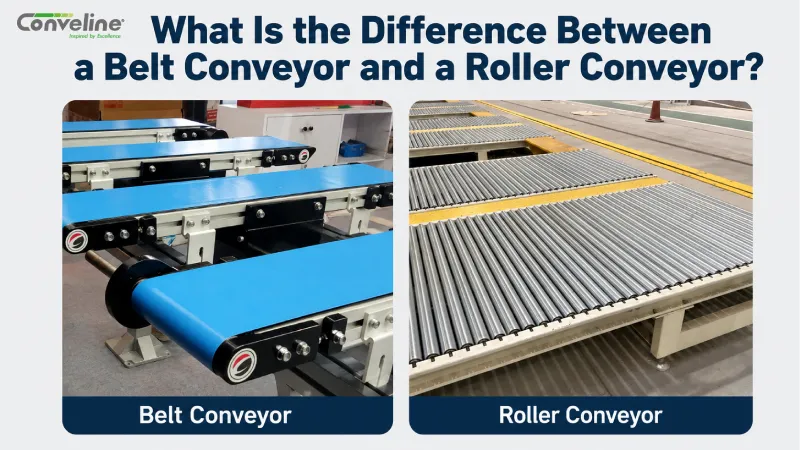
A belt conveyor uses a continuous moving belt supported by rollers or a flat surface to transport products. The belt is powered by a drive system that moves materials smoothly from one location to another.
Belt Conveyors Systems are commonly used for transporting cartons, packaged goods, lightweight products, bulk materials, and components that require stable movement during production or distribution.
Common Applications
- Manufacturing plants
- Packaging lines
- Food processing units
- Warehouses
- Distribution centers
- E-commerce fulfillment facilities
What Is a Roller Conveyor?
A roller conveyor transports products using a series of rotating rollers. Depending on operational requirements, the rollers may operate through gravity or powered mechanisms.Roller conveyors are widely used for handling products with flat, rigid bases such as boxes, pallets, containers, and industrial components.
Common Applications
- Logistics centers
- Warehouses
- Assembly lines
- Industrial manufacturing
- Material handling systems
- Shipping departments
Belt Conveyor vs Roller Conveyor: Key Differences
1. Operating Principle
A belt conveyor moves products using a continuous belt, while a roller conveyor moves products across multiple rollers.
2. Product Compatibility
Belt Conveyors Systems are suitable for products of different shapes, including items with uneven or smaller bases.Roller conveyors work best for products with flat and stable bottoms.
3. Material Handling Performance
Belt conveyors provide continuous product support throughout transportation.Roller conveyors support products at multiple contact points using rollers.
4. Application Flexibility
Belt conveyors are often preferred for products that require stable movement over longer distances.Roller conveyors are commonly selected for sorting, accumulation, and warehouse transportation.
5. Maintenance Requirements
Both conveyor types require routine inspection and maintenance, although maintenance schedules vary depending on system design and operating conditions.
Advantages of Belt Conveyors
Businesses choose Belt Conveyors Systems for several practical reasons.
Some key advantages include:
- Smooth product transportation
- Suitable for different product shapes
- Continuous material movement
- Reduced product slipping
- Adaptable to different industries
- Supports automated production lines
These advantages make belt conveyors a preferred choice for many manufacturing applications.
Advantages of Roller Conveyors
Roller conveyors also offer significant operational benefits.
Some common advantages include:
- Suitable for heavy products
- Efficient carton handling
- Organized warehouse movement
- Easy integration into distribution systems
- Flexible conveyor layouts
- Reliable material transportation
Both conveyor types contribute to efficient industrial operations when selected for the right application.
How to Choose the Right Conveyor
Before selecting a conveyor system, businesses should evaluate several important factors.
Product Type
The size, shape, and weight of products influence conveyor selection.
Production Process
Different production environments require different material handling solutions.
Facility Layout
Available floor space and workflow determine the most suitable conveyor configuration.
Future Expansion
Businesses planning future growth should consider scalable conveyor systems.
Industry Requirements
Operational conditions vary across industries, making application-specific selection important.
Working with a trusted Belt Conveyors Systems Manufacturer helps businesses choose conveyor solutions that match their operational goals.
Industries That Use Belt and Roller Conveyors
Both conveyor systems are widely used in industries such as:
- Manufacturing
- Warehousing
- Logistics
- Packaging
- Automotive
- Food Processing
- Pharmaceutical
- Engineering
- E-commerce
- Distribution Centers
Each industry selects the conveyor type based on its product handling and production requirements.
Why Quality Manufacturing Matters
The conveyor system works most effectively if all parts of it are engineered precisely. Effective engineering, quality materials, and good design help in making the movement of products effective and reliable.
We at Conveline Systems Pvt. Ltd. are experienced in designing conveyors that assist companies in achieving improved efficiency and better material handling. Our expertise in making Belt Conveyors System enables us to give you the best solution for your industrial needs.
Why Choose us
Our team at Conveline Systems Pvt.Ltd. is of the opinion that each organization requires a conveyor solution that suits its requirements. We try to comprehend our clients' manufacturing process in order to provide them with solutions that will help them enhance their work flow and increase the efficiency of their material handling. Our dedication to quality manufacturing, reliable engineering, timely services, and customer satisfaction has made us one of the most trusted Belt Conveyors Systems Manufacturers in the industry.
Conclusion
The decision regarding which one is better out of a belt conveyor and a roller conveyor will depend on your products, work processes, and goals. Belt Conveyors Systems are excellent when it comes to conveying items that need constant support, whereas roller conveyors are suitable for conveying cartons, pallets, and products that have flat bases. Knowing the above makes it easy to identify a conveyor system that will increase productivity. Working with a reputable Belt Conveyors Systems Manufacturer helps the industry to benefit from conveyor systems that help in organizing their processes and growing their business.
Looking for a trusted Belt Conveyors Systems Manufacturer? Contact Conveline Systems Pvt. Ltd. today at +919081915912 or email info@conveline.com to find the ideal conveyor solution for your manufacturing and material handling needs.
FAQs
Belt Conveyors Systems Belt Conveyors Systems Manufacturer Belt Conveyor Roller Conveyor Material Handling Industrial Conveyor Conveyor Systems Warehouse Automation Manufacturing Equipment Logistics Solutions

Table of Contents
- Introduction