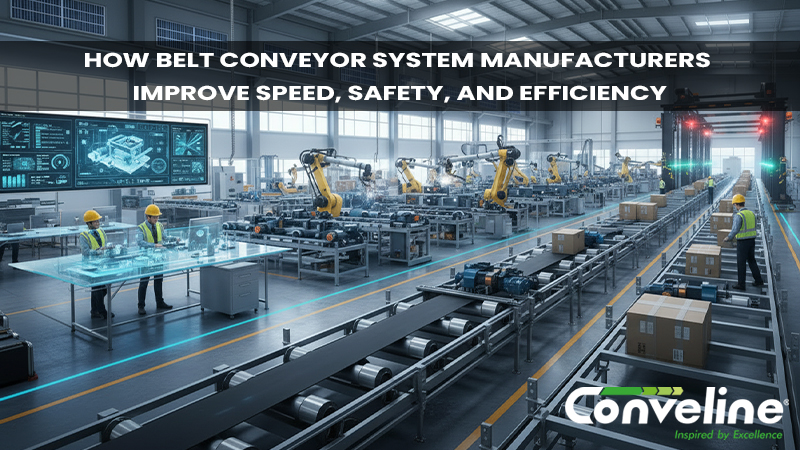
Modern industries run on speed, accuracy, and uninterrupted material flow. From raw material handling to final product dispatch, every stage of production depends heavily on efficient movement systems. At the core of this movement lies belt conveyors systems, a technology that has quietly become the backbone of manufacturing, logistics, mining, food processing, and countless other sectors. Their role goes far beyond simple transportation—they directly influence productivity, safety, operating costs, and plant efficiency.
Today, industries demand more than just mechanical movement. They require reliability, customization, automation compatibility, and long-term performance stability. This is why selecting the right belt conveyors systems manufacturer and understanding how these systems work has become a strategic business decision rather than a routine purchase. In India, rapid industrialization and automation have accelerated the demand for advanced conveyor solutions, giving rise to highly specialized belt conveyors systems manufacturers in India delivering globally competitive systems.
This in-depth guide explains how belt conveyor systems work, how they are designed, their technical features, industrial importance, and why choosing an experienced manufacturer directly impacts your operational success.
Understanding Belt Conveyors Systems and Their Working Principle
At their core, belt conveyors systems are continuous material handling solutions designed to transport goods smoothly from one point to another using a moving belt. The belt runs over pulleys and is powered by an electric motor through a gearbox. Once the motor rotates the drive pulley, the belt moves at a controlled speed, carrying materials placed on its surface to the discharge point.
Basic Working Mechanism
The working principle remains simple but highly effective:
- The motor generates rotational energy.
- The gearbox reduces speed and increases torque.
- The drive pulley transfers motion to the belt.
- Idlers support the belt and the load.
- The belt carries the material continuously along the set path.
This continuous looping motion eliminates manual handling at multiple stages, reducing both time consumption and operational risks.
Load Behavior During Operation
The performance of belt conveyors systems depends on how the load behaves on the belt. Factors such as weight, friction, moisture content, and load distribution directly influence belt tracking and stability. In inclined systems, gravity plays a significant role, requiring textured belts or cleats to prevent rollback.
Role of the Manufacturer in System Performance
A professional conveyor systems manufacturer calculates motor power, belt tension, speed ratio, and idler spacing based on real production conditions rather than theoretical assumptions. This engineering depth determines how smoothly and reliably the system performs over years of operation.
Key Components and Design Engineering of Belt Conveyor Systems
The durability and performance of belt conveyors systems depend on precision-engineered components working in perfect coordination. Each part is selected based on load type, duty cycle, environment, and desired throughput.
- Conveyor Belt: The belt is the primary load-carrying element and is manufactured using:
- Rubber for heavy and abrasive materials
- PVC or PU for food and pharmaceutical applications
- Fabric or steel-cord layers inside the belt to boost tensile strength and improve load-carrying capacity
- Heat-resistant compounds for high-temperature environments
- Drive Unit Assembly: The drive assembly consists of:
- Electric motor
- Helical or worm gearbox
- Flexible coupling
- Drive pulley
- Idlers and Rollers: Idlers support the belt and maintain alignment. Precision-balanced rollers minimize vibration and prevent uneven belt wear. Impact idlers at loading zones absorb material shock and protect both belt and structure.
- Frame and Structural Support: Frames are fabricated from mild steel, stainless steel, or aluminum based on the application. Structural rigidity protects alignment even under continuous heavy-duty operation.
- Control and Safety Systems: Modern conveyors integrate:
- Variable frequency drives for speed control
- Emergency stop switches
- Pull-cord safety switches
- Sensors for load and belt tracking
Benefits, Features, and Industrial Importance
The wide industrial adoption of belt conveyors systems is driven by their measurable economic and operational advantages.
Operational Benefits
- Continuous movement reduces production bottlenecks
- Minimal manual handling improves workforce safety
- Uniform material flow stabilizes machine cycle times
- Lower power consumption per ton compared to mobile handling
For facilities operating around the clock, these systems offer unmatched consistency.
Advanced Functional Features
Modern conveyor designs include:
- Modular construction for quick installation
- Automation compatibility with PLC and SCADA systems
- Customized belt surfaces for special material characteristics
- Low-noise operation for controlled environments
These features allow industries to tailor belt conveyors systems exactly to their workflow needs.
Strategic Industrial Importance
Industries such as cement, mining, food processing, pharmaceuticals, automotive, warehousing, and packaging rely heavily on uninterrupted material flow. Partnering with a reliable belt conveyors systems manufacturer directly influences uptime, output consistency, and long-term maintenance budgeting.
The rise of conveyor systems manufacturers in India has strengthened the global supply chain with cost-effective yet high-performance conveyor solutions.
Complete Technical Breakdown of Belt Conveyor System Design
Designing belt conveyors systems involves far more than placing a belt on rollers. It requires precise engineering based on real operating parameters.
Load and Capacity Calculations
Key design factors include:
- Bulk density of material
- Lump size and flowability
- Conveyor length and geometry
- Desired tons per hour
Improper sizing may lead to motor overload, belt slippage, or excessive energy consumption. This is why experienced belt conveyors systems manufacturers in India conduct detailed design analysis before manufacturing.
Speed Selection and Throughput Control
Belt speed is selected based on material fragility, required output, and safety standards. High speeds suit packaging and logistics, while bulk materials require moderate speeds for stability.
Environmental and Operating Conditions
Operating environments vary widely:
- Dust-heavy cement plants
- Hygienic food processing zones
- Corrosive chemical facilities
- Outdoor mining applications
Each environment demands customized material selection, protective coatings, and sealing arrangements.
Inclined and Declined Conveying
For upward or downward movement, engineers calculate gravitational resistance and select suitable belts with cleats or rough top surfaces. Anti-rollback devices are integrated where safety risks exist.
Maintenance and Lifecycle Planning
Well-designed belt conveyors systems offer:
- Easy roller replacement
- Accessible lubrication points
- Modular belt sectioning
- Standardized spare compatibility
Working with reputed belt conveyors systems manufacturers in Ahmedabad often simplifies on-site service support and spare availability due to regional proximity.
Industrial Applications of Belt Conveyor Systems
The versatility of belt conveyors systems allows their integration across nearly every industrial sector.
- Manufacturing and Assembly: Automotive, electrical, and electronics plants depend on synchronized conveyors to feed assembly stations, move components between work cells, and transfer finished goods.
- Food and Beverage Processing:Hygienic conveyors transport packaged and unpackaged food under strict cleanliness protocols. Belts with anti-microbial surfaces and washdown-compatible frames dominate this sector.
- Pharmaceuticals and Healthcare: Tablet movement, blister packing, and sterile product handling depend on vibration-free conveyors with precise speed control.
- Warehousing and Logistics: Sorting, accumulation, and dispatch lines in large distribution centers rely on high-speed belt conveyors systems for order fulfillment accuracy and time control.
- Mining, Cement, and Bulk Material Handling: Heavy-duty conveyors transport coal, ore, clinker, limestone, and aggregates over long distances with minimal manual intervention. This sector forms the backbone of large-capacity conveyor installations.
All these industries depend on trusted conveyor systems manufacturer expertise for long-term productivity.
Smart Automation and the Future of Belt Conveyor Systems
Automation has reshaped how belt conveyors systems operate in modern factories. Conveyor systems now integrate seamlessly with robotic pick-and-place units, automated storage and retrieval systems, and digital production monitoring platforms.
Predictive Maintenance Through Sensors
Sensors monitor:
- Belt vibration
- Motor temperature
- Load weight
- Speed fluctuations
Data analytics identifies early warning signs of wear, allowing maintenance teams to act before system failure disrupts production.
Why Choose Us – Conveline Systems Pvt. Ltd.
Conveline Systems Pvt. Ltd. has built its reputation on application-focused engineering, manufacturing discipline, and dependable long-term service support. The organization approaches every conveyor project as a unique operational challenge rather than a standard fabrication task. With deep expertise in customized conveyor design, strict quality control, and performance-driven manufacturing, Conveline Systems Pvt. Ltd. delivers material handling solutions that align precisely with real production conditions. Clients value the company’s consultative engineering approach, transparent project execution, and strong post-installation support that continues long after commissioning. For industries seeking reliability, engineering accountability, and sustained operational performance, Conveline Systems Pvt. Ltd. represents a technology partner rather than just a supplier.
Conclusion
Belt conveyors systems have evolved into essential infrastructure for modern industrial operations. Their ability to move materials continuously, safely, and efficiently makes them indispensable across manufacturing, logistics, food processing, and heavy industries. From design engineering and component selection to automation integration and long-term maintenance planning, every technical detail influences real-world performance. Partnering with an experienced manufacturer transforms a simple conveyor into a strategic production asset. As industries advance toward automation and smart factories, investing in properly engineered belt conveyors systems delivers sustained productivity, operating stability, and measurable cost efficiency across the entire production lifecycle.
For high-performance customized belt conveyor solutions, Call +91 9081915912 or email info@conveline.com to discuss your application with our engineering experts today.
FAQs
- What factors determine the capacity of belt conveyors systems?
Capacity depends on belt width, belt speed, material density, lump size, and conveyor inclination. Accurate calculation by experienced conveyor systems manufacturers in India is essential for stable performance and motor safety. - How long do industrial belt conveyors systems typically last?
With proper design, regular maintenance, and quality components, industrial belt conveyors systems can operate reliably for 10 to 20 years depending on load intensity and environmental exposure. - Why is Ahmedabad a major hub for belt conveyors manufacturing?
The presence of strong fabrication infrastructure, skilled engineering manpower, and diverse manufacturing industries has supported the rapid growth of belt conveyors systems manufacturers in Ahmedabad. - Can belt conveyors systems be customized for space-constrained facilities?
Yes. Customized layouts using inclined, curved, or multi-level conveyor arrangements allow efficient material movement even in highly restricted production spaces. - How does Conveline Systems support conveyor installation and service?
Conveline Systems Pvt. Ltd. provides design consultation, manufacturing, installation supervision, commissioning assistance, and responsive after-sales service to support long-term conveyor performance.